Roguelites: Ark's Wonder Dungeon
I was debating on whether or not I wanted to do this now or save it for later. Ark's Wonder Dungeon is from my perspective deeply inspired by Binding of Isaac in a lot of small and big ways and makes for a perfect continuation, so that's why I ended up writing this right afterwards.
If you've at all been in my vicinity, you'll know that I really like this game. There's something about combining your typical JRPG combat with the randomization, run-based gameplay and metaprogression that I really enjoy. At least one reason why is because Lufia 2's Ancient Cave is possibly one of my favorite side modes in any JRPG out there. Surprisingly, this combination is quite rare! The games I can think of and have played, off the top of my head:
- Ark's Wonder Dungeon (<-- we're here)
- Time Break Chronicles
- New Meat
- Lufia 2's Ancient Cave
- and the quite robust romhack scene around Ancient Cave hacks
- Soul Survivor Trials of the Goddess
- Star Renegades
- Splintered
(granted, while roguelikes are universally turn-based there's a fundamental distinction between something like Shiren the Wanderer and a JRPG in terms of how battles play out. At least in my opinion)
Of the ones I've played, Ark's Wonder Dungeon stands out as I think the best and most fully realized one. It's a smart combination of baseline JRPG mechanics along with taking mechanics from other popular roguelites and tweaking them in positive ways.
Ark's Basic Dungeon
The game as a JRPG uses a simplified set of stats for your party: ATK, DEF and AGI are the primary trio that items will affect. HP/Mana are your resources for Not Dying and Fighting respectively. There's also elemental resistances (fire/air/water/earth), but every character starts at neutral so you only really care if something buff/debuffs it or if you're fighting enemies in particular biomes. Your party has a collective total weight and a weight max, which includes whatever items you have equipped. So if you hoard or steal too many items, you'll receive a hefty speed penalty and will be expected to toss them at something.
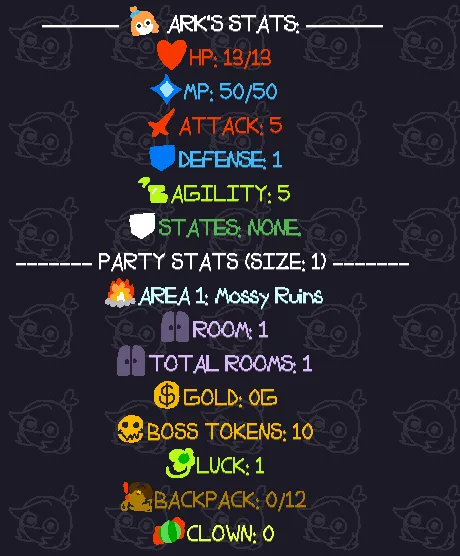
(There's a few other stats, but we're only going to focus on Luck. I'll leave it to you to figure out what Clown truly means)
Ark's Pool Dungeon
Much like The Binding of Isaac, Ark's uses an expandable item pool for denoting player progression. Unlike Isaac however you are strictly limited in the total number of items you can equip: each character can only hold 7 items. And once they're full, that's it. The total pool of items starts out fairly small, but very quickly expands as you complete achievements.
Achievements (conveniently viewable at all times through either the book in your inventory or at the top left corner of the main menu) dictates all of the items, events and upgrades you can unlock. Characters can unlock direct upgrades which expand their kit and there's a few global upgrades as well.

Importantly, just about every item you unlock is adding additional power to your overall pool of items. And the early game items stay relevant through things like synergies, leadership passives or helpful buffs.
There's a few other item mechanics. You've got shopkeepers which'll show up every now and then letting you buy items for gold; biomes can have rooms with biome-specific items and allies will occasionally start with an item themed to their character.
The most important mechanic however is luck. Items all have a rarity, and the higher your luck stat is, the more often items appear and the higher the rarity of said items. It's not a minor change either, going from 2 to 5 and from 5 to 8 luck can make your run feel vastly different. There's a number of items and ways to manipulate your luck, and because of how luck functions it can be hard to see how truly effective it is. Luck as a mechanic is super important for how the game deals with the restart problem.
Ark's Restartless Dungeon
There's a few different 'pity systems' built into the game. Every time you fail a run, you get to take one item from that run in question and send it to the next run. It will only appear in the environment you died on, so the game gives you an incentive to play out the next run so you can grab your favorite item that you lost. Additionally, every failed run increments your base luck by +1, so eventually you'll find higher rarity items to carry your run.
This might seem like a bit much, but it works out really well in practice. It helps push players through the game without overtly giving them a free win, and it means you always want to play out a run even if it ends up going badly. Every failed run is progress in the next run.
Ark's Difficult Dungeon
Despite how much control you have as a player, snowballing is surprisingly difficult. Enemies can be deadly and take out a party member with bad turn planning, bosses have no issue slapping you if you haven't been preparing and knowing how and when to use your character's unique abilities is crucial.
One of the core mechanics the game uses for difficulty is Enraged. Every biome has 99 floors and past floor 50, enemies will gain additional stages of Enraged which heavily buffs their stats and gives them new moves. If you're looking for specific items or bosses though, the game expects you to deal with Enraged floors so there's always a bit of calculus as to whether or not you should prioritize moving to the next floor, or staying on your current one for gold, items or potentially finding another party member. Learning to manage Enraged gradually becomes an important part of your strategy.
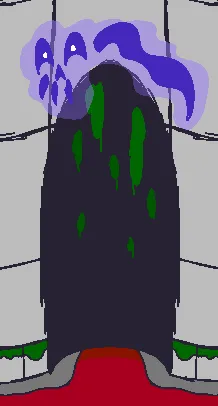
(if you see this, you're in for a worse time)
Your choice of leader will also greatly impact your general strategy and how you prioritize items. Ark for example gets stronger the more dead allies are in your party, and since she has a party-wide revive this means going into bosses with just her alive isn't just a detriment but actively beneficial. John gets massive stat boosts from books and can share spells with the party, so an otherwise mediocre book allows him to punch well above his weight.
Ark's Critic Dungeon
There are some mechanical missteps here and there though; due to a combination of contorting the RPG Maker engine into something far outside what it usually does and just a smidge of indie jank.
When playing the game you'll generally be expected to memorize what buff/debuffs do what and why. You can hover over them once applied to an enemy/ally, but in the tooltip they'll just display an icon which can often not explain anything. This sounds a bit worse than what it's like in practice since if you just experiment with abilities on random enemies you'll figure it out fairly fast, and there's different classes of debuffs/buffs where they all do similar things and share similar iconography. I have seen a few folks bounce off the game because of this though.

(an example of the issue, it explains the Ark icon but not what glass does)
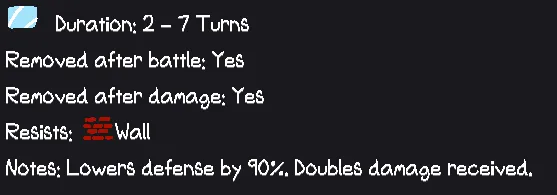
(the encyclopedia helpfully explains most of the states, but diving into to figure out what something does can be time consuming)
Items sometimes have a similar issue, but that's been fixed for the most part. If an item grants an ability though you'll just have to trial by fire it.
Combat can sometimes fall into a bit of 'status effect hell' depending on your items and what boss you're facing. It's a problem I've seen across a few RPG maker games that go for more mechanically intense combat, but the game is still comprehensible during these moments.
Bugs can be expected here and there, from rare game crashes to sometimes things not rendering properly. The game has a very generous autosave at the start of every biome, so restarting the game does not result in much lost progress.
And finally, the game only has partial controller support. You can easily setup Steam to create controller bindings for it (something I did and published, for people that want a base template) but something to keep in mind. In combat everything works fine, it's mostly out of combat and navigating the menu where you can see why it uses KBAM.
Ark's Wonder Dungeon
That about covers it. There's a bit more I could say regarding the story but I wanted to keep this spoiler-free if I somehow convinced you to give it a shot. I will say though I think the story only gets better the more you play it, and it manages to stick the landing where many RPGs stumble at the last mile.
I've put over 100 hours into the game (with 40 being needed to beat it) in total and there's still a lot more things I need to do. The game likes to throw new modes or items or hidden bosses at you in ways you least expect it, and the game only costs $4 so if you're a time:money fiend the game is more than worth it.
I think some folks might immediately discount it because of the aesthetics but there truly is a lot of care put into every aspect of the game.
If you're interested in giving it a shot, you can purchase the game on Steam here and you can support the composer here